


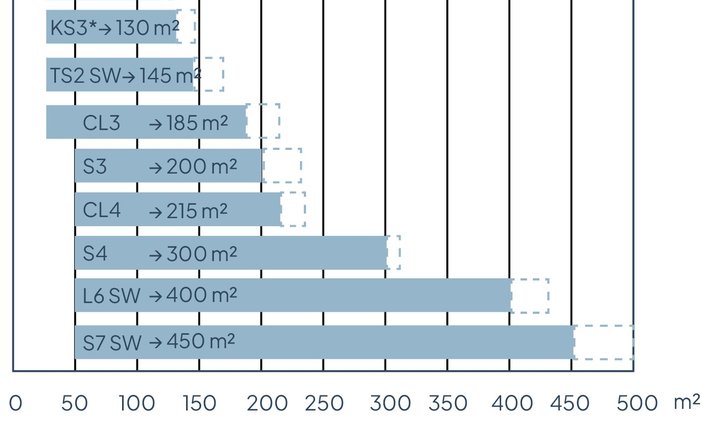
New rotating heat exchanger technology with sky-high performance
The new rotating heat exchanger has been developed at Flexit's R&D center in Sweden, based on a research project together with Sintef and NTNU.
These data are real values measured in air handling units, not just theoretical calculations or extrapolation.
– We have measured and verified the heat recovery in normal operation up to 10 percentage points higher thermal efficiency compared to today's rotating heat exchanger technology, so it is a real improvement, Knut emphasizes.
He points out that the increase applies to dry conditions thermal efficiency measured in air handling units.
– Our mantra throughout the years has been that our products are developed and suited for cold and demanding climate conditions; we do not compromise on that, Knut states.
Groundbreaking for residential air handling units
- This is ground-breaking for our residential air handling units, says Daniel Nielsen, Product Manager for Flexit’s residential units.
Being able to recover up to 10 percentage points more ventilation heat from a home provides a major energy saving. The benefits of Stage Wheel technology don’t end there. It also means that we can build more compact ventilation units, maintain a high thermal efficiency or you can choose to design for reduced pressure drop to reduce energy consumption and noise levels. There are many positive synergies here that also provides greater flexibility for architects and consultants, Daniel points out.
Studying an overlooked feature
Rotating (condensing) heat exchangers have been used in residential ventilation units for the past 20 years. Heat exchangers have been constantly improved, with efficiencies of up to 85%. With our new rotating heat exchanger technology, we have shown in measurements a dry thermal efficiency of up to 95% in ventilation units.
How does the Stage Wheel still manage to make such a big technological leap?
– It started with us taking a closer look at a feature that is often considered negligible and is therefore overlooked in calculations, says Anneli Halfvardsson.
Anneli Halfvardsson is a Research and Technology engineer at Flexit's R&D center and the brain behind Stage Wheel. She is also active in Swedish Ventilation Association and Eurovent's product groups as well as the Norwegian representative in CEN/TC156 WG2.
– We started a research project together with Sintef and NTNU in 2016; Energibolig. There, as a small work activity in a long list of project content, we wanted to mathematically explain why the thermal effiency declines at lower air flow rates, says Anneli.
Material selection for extremely high heat recovery
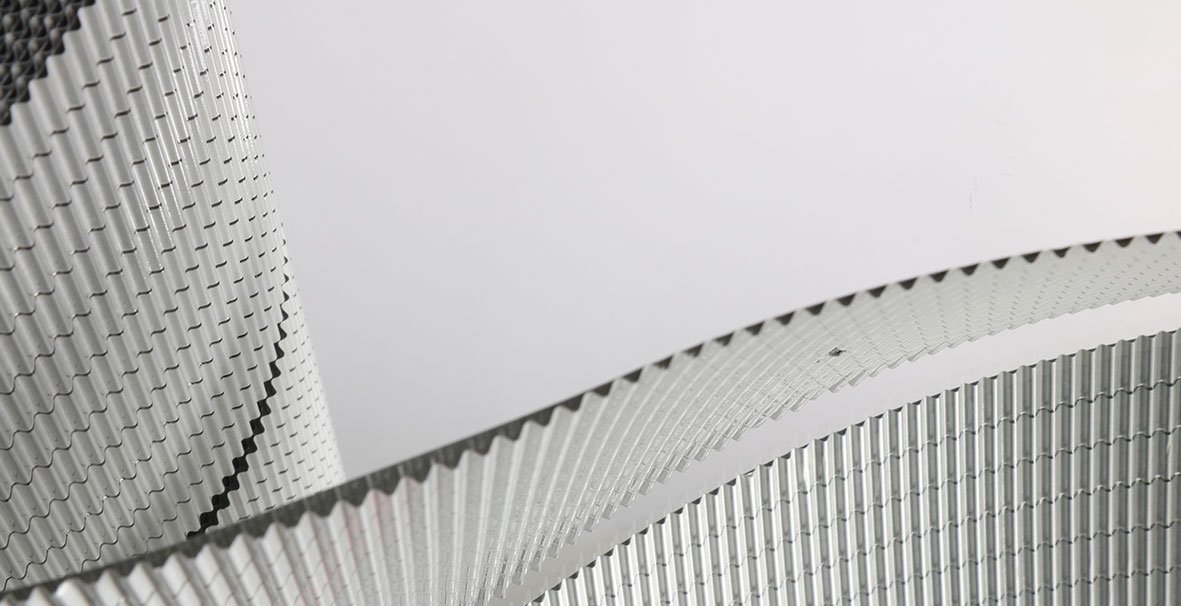
A combination of material, material thickness and precise geometry provides sky-high heat recovery for the rotating heat exchanger.
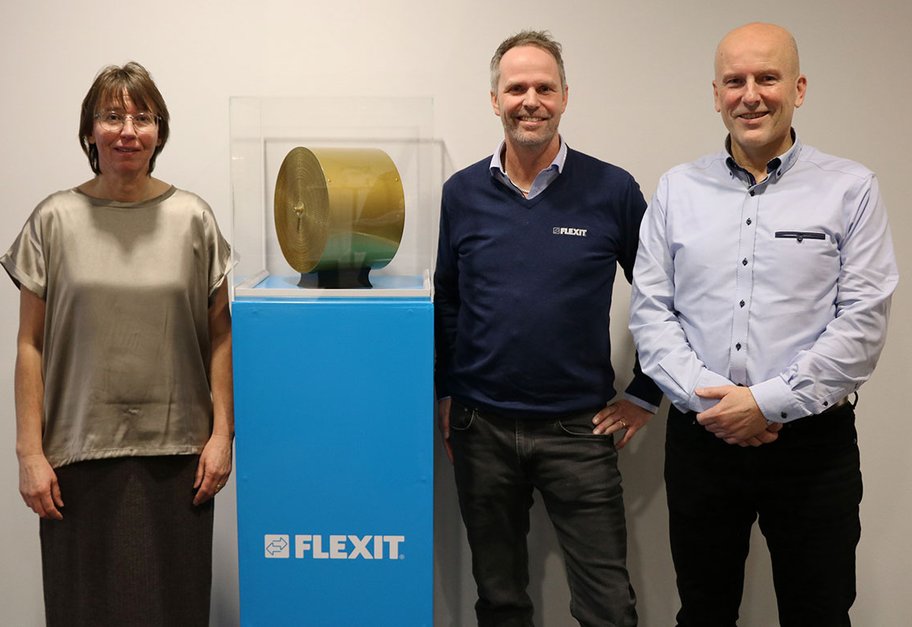
Pictured from left: Anneli Halfvardsson – Research & Technology Engineer, Daniel Nielsen – Product Manager and Knut Skogstad – Flexit CEO together with the Stage Wheel painted in gold.
Longitudinal heat loss
The researchers had set aside four hours to describe why heat recovery declines at lower air flow rates, but the entire project had to be reprioritized.
- The reduction in performance for the low air flow rates could partly be explained with longitudinal heat conduction, that is, heat loss. We understood that we had to investigate this further, says Anneli.
Peng Liu, a researcher at Sintef, carried out a series of calculations to see if it was possible to reduce these heat losses.
- We saw calculations that showed very high potential, says Anneli.
Breaking heat conduction with polymers
The big challenge was to translate theory and calculations into a real product.
Anneli Halfvardsson and a colleague worked on developing prototypes on seven completely different tracks and all the prototypes were tested at Eurofins in Helsinki. One of Anneli's tracks was the Stage Wheel. The first test didn't go so well, but she was sure it should work and made a new prototype with slightly changed properties.
– The results were so good that the laboratory staff stopped the test and started troubleshooting the lab, she says with a smile.
The good results are about a combination of material, material thickness and geometric shape.
– By combining aluminum and polymers, we are able to break the longitudinal heat conduction parallel to the airflow, Anneli explains.
She clarifies that the geometric shape of the cells is just as important as the material.
– It has to be precise all the time and has to be adapted to the material, emphasizes Anneli.
Residential ventilation with energy class A+
In summary, the design provides an optimized Nusselt number, a measure of how efficient the thermal effiency is for the selected design and material. Stage Wheel requires a completely new production process, and its development began when the research project was completed in 2019. In addition, the research department has tested performance over time and performed stress tests to ensure endurande, but also made measurements to build a database of thermal efficiency and pressure drop.
– The first products with Stage Wheel will be released on the market in the first quarter of 2025 and they will reach energy class A+, says Daniel.
– We are proud that we have a position in the market that allows us to invest long-term, and that we have an environment with talented people who can work on research and development over time. Our specialists are here in Töcksfors in Sweden and drives the development for products suited for cold and demanding climate conditions, Knut points out.
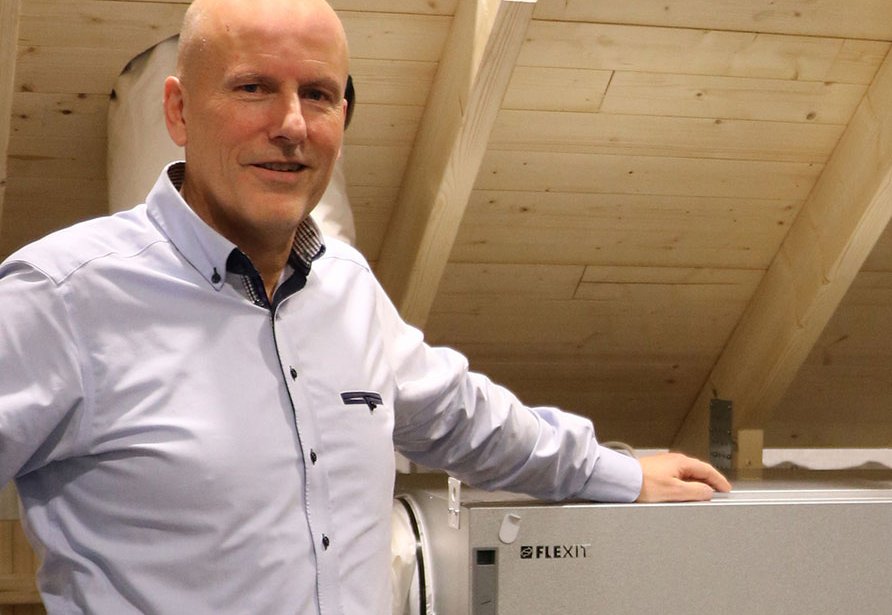
– The common thread in our research and development work is that we want to make residential ventilation more energy efficient without compromising on a good indoor climate, says CEO Knut Skogstad.
– The common thread in our research and development work is that we want to make residential ventilation more energy efficient without compromising on a good indoor climate.
CEO Knut Skogstad
Two new models featuring Stage Wheel technology

For more information, please contact:
Knut Skogstad, CEO, Flexit AS/Flexit Sverige AB
+47 932 30 202